OTBN 2026 – What a night!
Open That Bottle Night (OTBN for short) is one of my favorite wine holidays of the year – possibly simply the favorite.
The event, always taking place on the last Saturday in February, was created by Dorothy J. Gaiter and John Brecher, writers of the Wall Street Journal wine column, 27 years ago. The purpose of the event or a holiday, if you will, is simple. Every wine lover has a special bottle waiting for a special moment. Let’s declare that special moment has arrived, and let’s open that special bottle to enjoy it now – nobody knows what’s ahead in life, so we should enjoy things while we can.
As I said, this is possibly my favorite wine holiday, I always make an effort to participate, and a few times even wrote about them (here are posts from 2016, 2019, 2020, 2023, and 2025). Whether I’m celebrating with friends or just with my wife, I always make an effort to make that day wine-special – I believe I have never been disappointed so far, judging by “what a night!” being a favorite descriptor.
OTBN 2026 was no exception. Typically, my OTBN experience starts with self-inflicted drama – what to open???? I have more than a few bottles worthy of a “special” designation, and it is always hard (very hard!) to decide which one or two should be called special in a given year. In 2026, somehow I managed to solve this conundrum somewhat easily – the decision just materialized on its own as I was mindlessly moving wine cabinet shelves in and out.
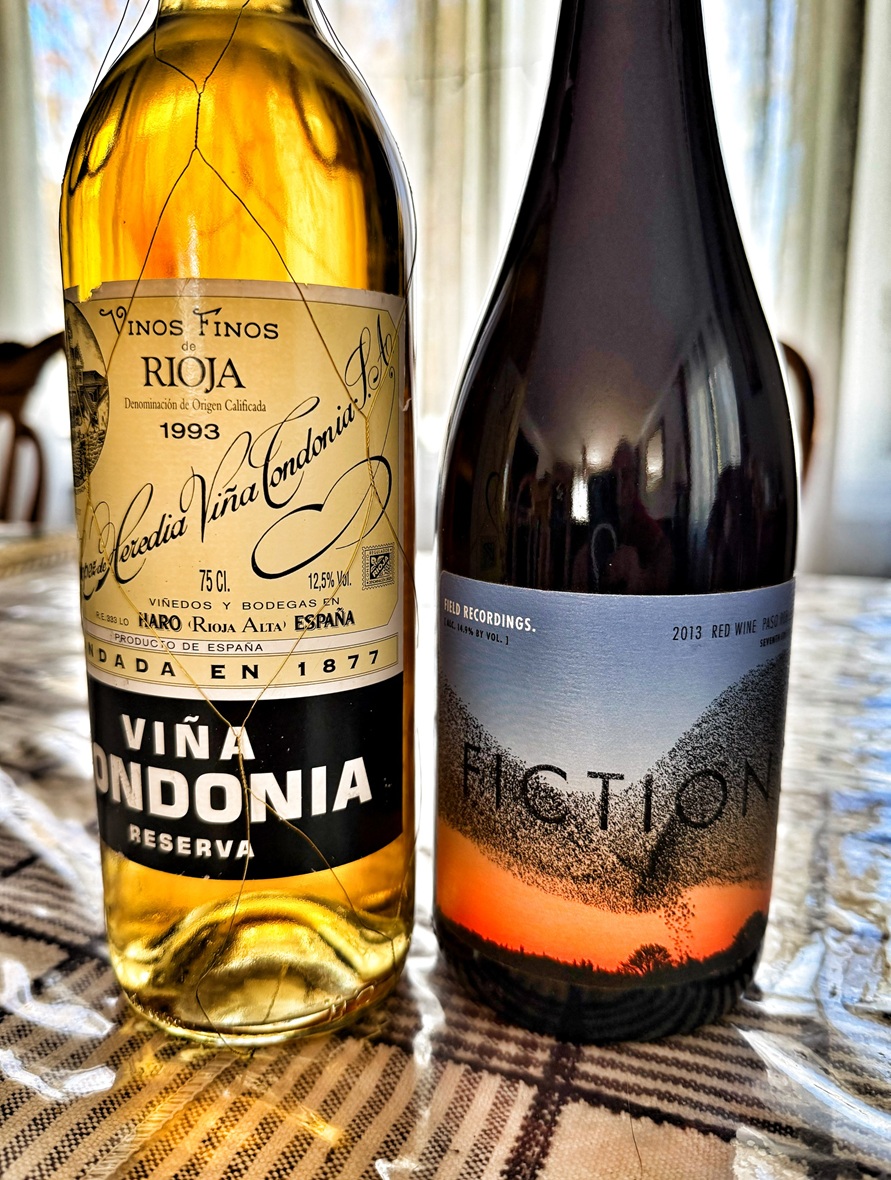
Lopez de Heredia needs no introduction to wine lovers. Way, way back, Lopez de Heredia Blanco was my first foray into white Rioja wines, and I have been a devoted follower ever since. Fiction by Field Recordings was the first wine that led to the discovery of the Field Recordings wines 17+ years ago, and it has been a perennial staple ever since. I can’t say what led to the decision on the 33-year-old white Rioja and 13-year-old California red blend, but this became one of the most memorable wine experiences ever.
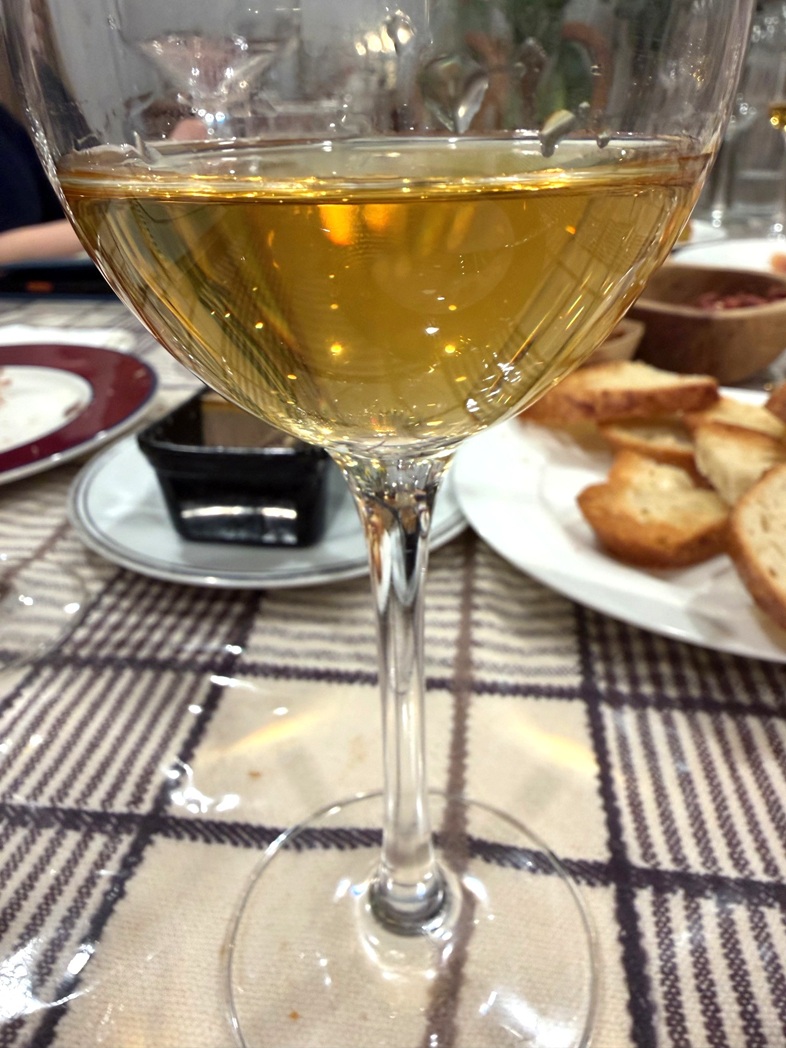
Let’s talk about 1993 Lopez de Heredia Viña Tondonia Blanco Rioja (12.5% ABV). I have to start by saying that I’m not a fan of oxidative white wines. When I mentioned on Twitter that I plan to open this bottle for the OTBN, some comments expressed excitement about oxidative and nutty notes, which I was supposed to find, similar to what you would find in a glass of Jerez. And so I was expecting to find that, and was wondering if I would be able to like that wine. And then there were literally none! Nothing oxidative on the nose, mostly minerality and whitestone fruit. And then a beautiful, complex, powerful structure on the palate, somewhat along the lines of a good Roussanne, still with perfect acidity and freshness. Oxidative notes were lurking in the background, showing up and instantly dissipating a few times, but those were only tiny glimpses, not taking anything away from the wine. An absolutely delightful experience, a 33-year-old white Rioja possibly at its peak (but I wouldn’t dare to insist).
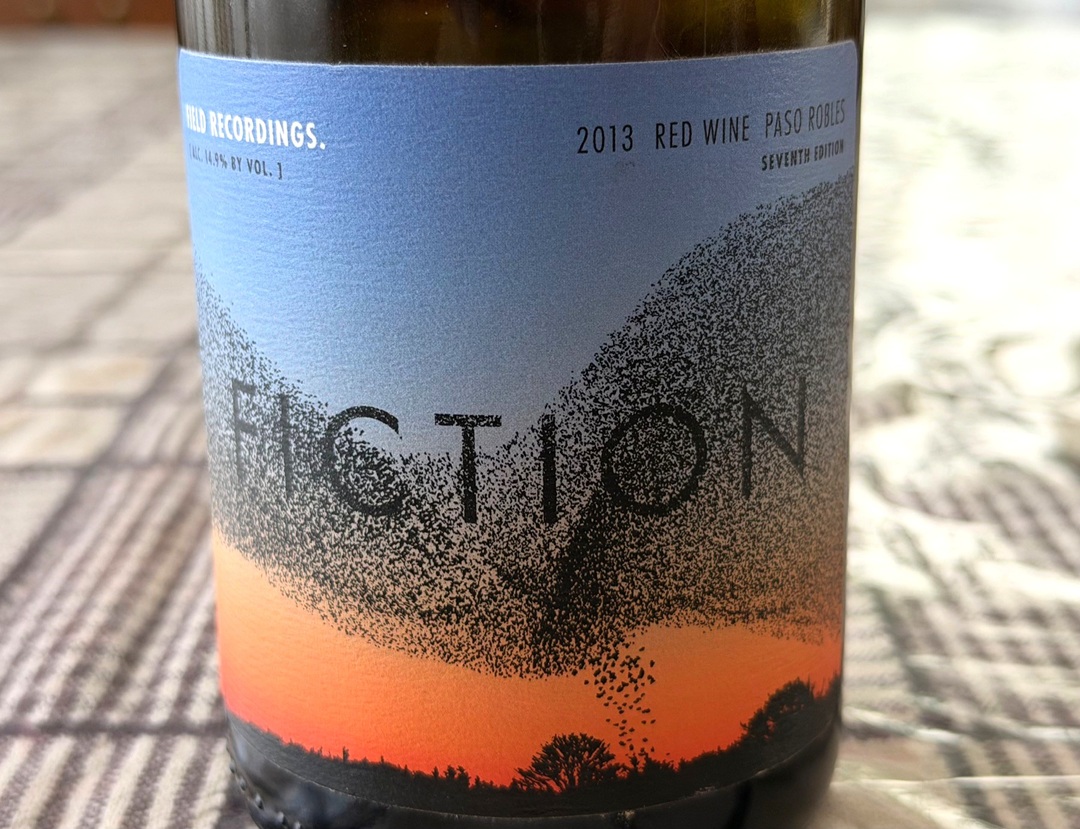
And then there was 2013 Fiction by Field Recordings Paso Robles (13.5% ABV, 31% Zinfandel, 26% Tempranillo, 15% Mourvèdre, 10% Grenache, 10% Syrah, 8% Touriga Nacional). This was my only bottle with an original label, which I really loved and much prefer to the current ones. There is nothing wrong with the current label, only that the original one, with a flock of birds, was conveying the message of bottled poetry a lot better – or rather music, as I wrote in my first post about this wine, Music, Recorded in the Vineyard.
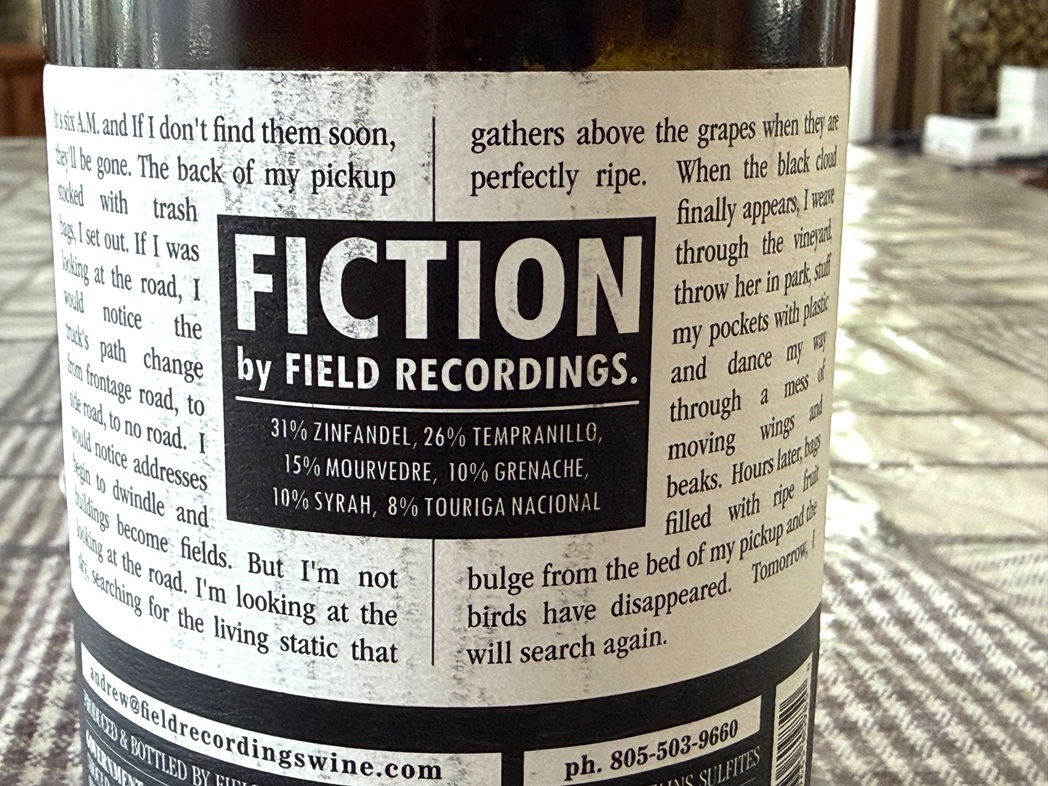
I also loved the back label. As this might be the last time I look at such a label (the current ones don’t carry any of the text), I would allow myself to cite the text written on that back label:
“It’s 6 A.M. and if I don’t find them soon, they’ll be gone. The back of my pickup stocked with trash bags, I head out. If I was looking at the road, I would notice the truck’s path change from frontage road, to side road, to no road. I would notice addresses begin to dwindle and buildings become fields. But I’m not looking at the road. I’m looking at the sky, searching for the living static that gathers above the grapes when they are perfectly ripe. When the black cloud finally appears, I weave through the vineyard, throw her in park, stuff my pockets with plastic and dance my way through a mess of moving wings and beaks. Hours later, bugs filled with ripe fruit, bulge from the bed of my pickup and the birds have disappeared. Tomorrow, I will search again.”
Now, let’s talk about the wine. Screwtop. 13 years old California Paso Robles blend. Stored at somewhat consistent conditions, away from direct sunlight and vibration, but not in the cellar or a wine cooler. Priced at not more than $20 originally (directly from the winery). And yet, one of the very best wines I have ever experienced. A truly memorable one.
I poured the wine in the glass, smelled it, and couldn’t put the glass down. The time slowed down. Sounds practically disappeared. The aroma was magical. And the wine in my mouth was too.
Dreams, smiles, baby laughter, endless meadows, fresh mountain forest air. I know, it sounds like a brain dump, but I don’t want even to try to describe this wine in technical terms – raspberries or blueberries are not important here, what’s important is how the wine makes you feel. Refined, elegant, layered palate, flavors are transitioning and interplaying in total harmony, each sip asking for the next. Am I exaggerating? I don’t know, and it is up to you to believe me or not. But the wine was absolutely stunning and memorable. That I’m completely sure about.
Here you are, my friends. An OTBN experience that will not be easy to beat.
Two amazing wines, an amazing experience, great memories.
I don’t know if I will be able to do better next year, but this is the beauty of wine – the mystery in the bottle.
Until the next time – cheers!
FeedSpot Top Wine Blogs 2026
 The best pleasures in life are unexpected ones, right?
You grab a bottle of wine. You know nothing about it. Open, swirl, sniff, sip. Whoa. OMG.
Unexpected. Delightful. Pleasant.
Wine might be the best carrier of unexpected pleasure. Of course, you can always win a lottery – but that is reserved for the selected few, and in many cases, the pain comes right after the pleasure. And then there are unexpected emails. Not, not the ones when you are informed that your unknown uncle passed away in the other hemisphere, and your millions are in the mail as long as you pay the modest fee of $5k. No, I’m not talking about those.
A few days ago, I got an email from FeedSpot informing me that my blog made the 100 Best Wine Blogs to Follow in 2026. Unexpected. And pleasant.
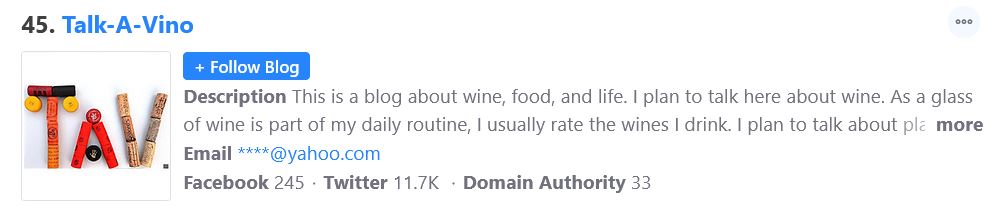
Last year, I also made the Top 100 list of 2025, so I’m definitely happy to receive the recognition again. Scrolling through the list, I find many familiar names, so kudos to all who are still happy to share their passion for wine.
Now I’m off to write about the delicious Amarone I recently had the pleasure of experiencing…
Daily Glass: The Mood, The Vintage, Or Something Else?
Carlisle is one of my favorite California wine producers (who is, unfortunately, about to close the operation, but this is not the subject of this post). Carlisle is very well known for their Zinfandel wines, but their Rhone-style wines (Syrah, Petite Sirah, Grenache, Mourvedre, and others) are also excellent. I love their wines and have been on the mailing list for more than 10 years. I’m rarely disappointed by Carlisle wines, and yet I had a few “interesting” experiences.
Two years ago, in January of 2024, I opened a bottle of 2016 Carlisle Two Acres wine, and it turned out to be one of such “interesting” experiences. I didn’t like the wine, not when it was just opened, nor over the next few days it remained open. The wine was lacking balance, and since that time, I had a bit of trepidation whlie considering opening Two Acres again.
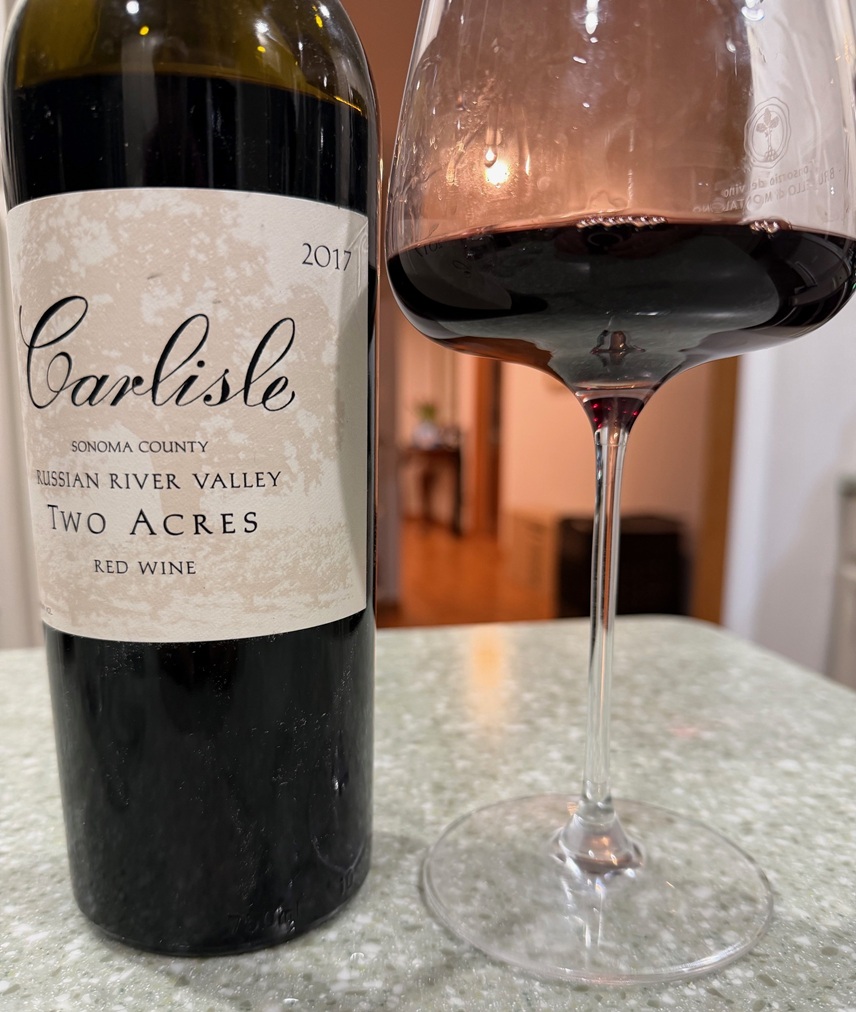
Today, I decided to give it another chance. This time, it was a 2017 Carlisle Two Acres Russian River Valley (14.9% ABV). Different vintage, a year difference in ageing (8 years versus 9 years). And the wine couldn’t be more different. Almost black color, dusty cherries on the nose, beautiful legs (couldn’t help but notice). Dusty cherries and herbs on the palate, perfect firm structure, full body, power and elegance, and perfect balance. This was one delicious wine. (Drinkability: 8+/9-)
There is a reason for the wine’s name Two Acres. The grapes for this wine come from the 2-acre vineyard parcel, which was originally planted in 1910. Carlisle took over the parcel in 1996, when the vineyard was practically dying, and restored the vineyard to full health in 2003. The original vineyard was planted with the Mourvèdre grapes, with the addition of Syrah, Petite Sirah, Carignan, Peloursin, and Alicante Bouschet. According to the Carlisle website, there are also a few Zinfandel vines in addition to nine whites of a variety called Helena (a white cross of Zinfandel and Mondeuse noir). Also, Two Acres wine is produced as Field Blend, which means that all the different grape varieties are harvested and processed together, without separating by varieties.
And now is the question – how come? How come I really didn’t like 2016 and loved 2017? Was there something with my mood? The difference between the vintages? On odd bottle? Of course, we will never know, but the analysis, even if futile, is still a part of the geeky wine fun.
I checked the Wine Spectator vintage chart for Rhone varieties in California, and according to the chart, 2016 was supposed to be far superior:
2016 – “A textbook vintage with nearly ideal growing conditions throughout the year”
2017 – “Dramatic weather conditions, from floods to heat waves to wildfires, led to a variable, challenging vintage”
And yet I liked 2017 a lot more. Of course, my 2016 could’ve been just an odd bottle. Or maybe I had a root day. Or just simply a bad day.
We will never know, because you can’t enter the same river twice. But if anything, I think my trepidation towards Carlisle Two Acres is now cured. And I’m ready to taste another bottle.
Until the next time – cheers!
P.S. Just for fun, a Day 2 update:
The wine evolved, now adding a touch of nutmeg, balsamic, and iodine, smothered on top of delicious black cherries with perfect acidity to support the new expression and keep the wine lean and firm, with an unnoticeable ABV. As I said before, a treat.
Daily Glass: Pure Pleasure
Of course, it is Wine Wednesday – but this was just a happenstance. Not anything I planned.
A traditional dilemma – what to open?
Checked one wine fridge – no, nothing spoke to me. Next thought – maybe Field Recordings?
Again, without much thought – how about that bottle? I passed it a few times before. What vintage is that? Oh, 2019, that might be good. Ha! It is also a Syrah! Nice, my wife loves Syrah, might be her favorite red grape. Prefect, we have a bottle to open.
Talk about wines made in the vineyard. I discovered Field Recordings wines almost 15 years ago. At that time, the wines were more of a side project for Andrew Jones, a consulting grape grower. By nature of his profession, Andrew had relationships with many grape growers. More importantly, he knew the best plots in their vineyards, and thus he knew where to find the best grapes when he needed them. And little by little, Field Recordings became a powerhouse and a darling of Paso Robles, with the wines of unbound creativity.
My first Field Recordings wine was the wine called Fiction – here is my post about that experience: Music, Recorded in the Vineyard. This was love at first sight. Fiction by Field Recordings was my wine of the year in 2011. And Field Recordings is the only wine club I ever joined, and I’m still a member there. Over the years, there were literally a handful of Field Recordings wines I didn’t enjoy, because for the most part, my favorite descriptor for the Field Recordings wines is probably “mind-blowing” or maybe “mind-boggling”. As was the case today.
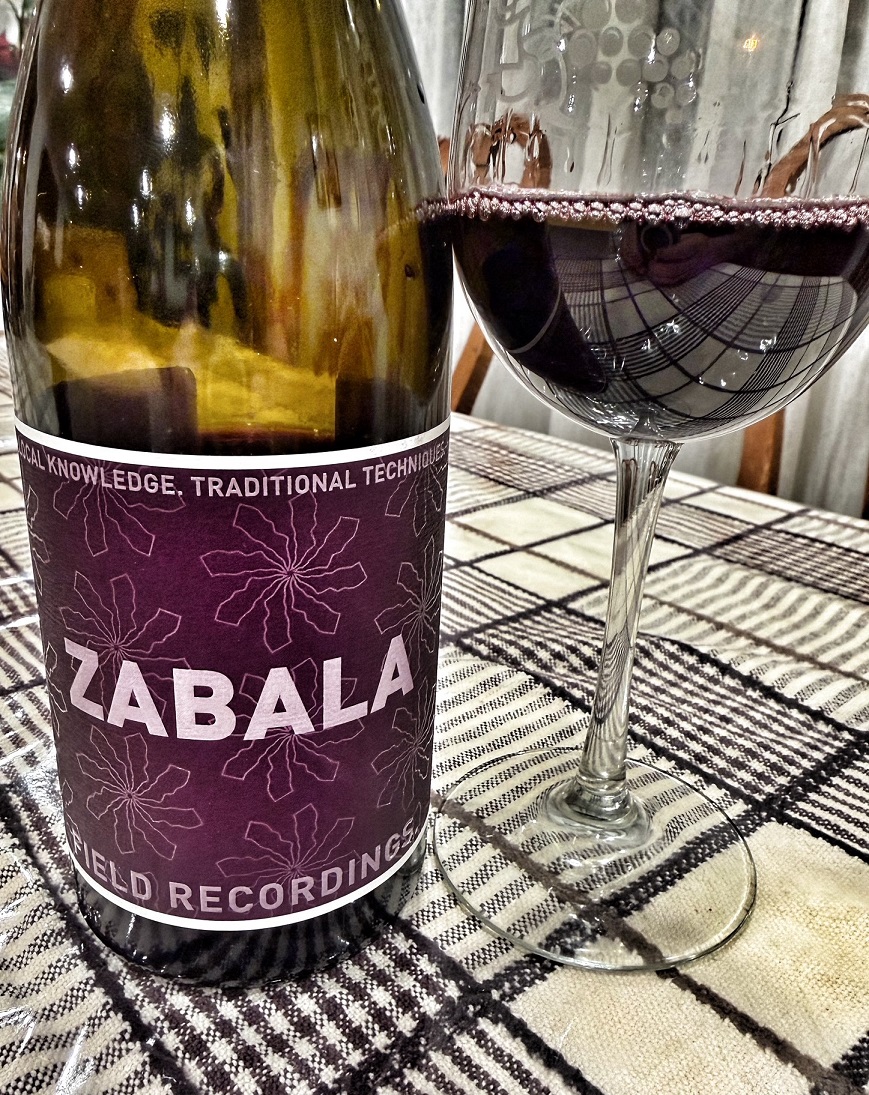
I opened the 2019 Field Recordings Zabala Zabala Vineyard Arroyo Seco (12.9 ABV, 100% Syrah) and poured it in the glass right away. The first whiff had a bit of the funk (love funk!) and a bramble. But on the palate… Oh my, the palate was a pure symphony. Well, a caveat – you have to love black pepper to call that experience a symphony. The palate was full of freshly ground, gorgeous, salivating black pepper. I experienced such purity only once before, while tasting the 2011 Michel Chapoutier Tournon Mathilda Shiraz from Australia. I was blown away by the purity of the pepper expression in that wine – and interestingly enough, after that first experience, I had a random success with the same vintage over a few years – but this is not the subject of this post.
This Zabala Syrah was literally mind-boggling (see, told ya, I just can’t avoid it). Dark bramble fruit, a little bit of funk, and lots and lots of freshly ground black pepper. Delicious, perfectly balanced, perfectly harmonious. A pure pleasure in the glass.
Maybe I just got lucky. I don’t have another bottle from the same vintage, so I will not be able to taste it in a year or a few years and report back. But we should enjoy the moment, and this moment in wine was immensely enjoyable. Wine should give you pleasure, and this was a pure pleasure.
So, what was your last mind-blowing wine experience?
Simple Recipe: Chicken Liver Pate
It’s been a while since I published any recipes on this blog. It doesn’t mean, however, that I don’t have any recipes to share. So let’s correct it.
As the title says, I like simple recipes. The meaning of “simple” is relative. For example, I’m sure that the absolute majority of people consider an omelette simple – both in recipe and in the making. And yet making an omelette can be a test for the chef, which is easy to fail. And take a look at the Japanese omelettes, those that are oozing when sliced on top of other food. Good luck making those in your home kitchen. Simple? Maybe not so much.
In my book, simple means primarily the way of cooking. For example, chicken legs or braised beef in the slow cooker are simple – put together all ingredients at once, turn it on, close the lid, walk away, come back in 6 to 8 hours for a delicious meal. That is what I call simple. Making delicious onion soup, on the other hand, is very far from simple. Despite a very few ingredients, the process is very involved – look away, and you will have to start all over. I’m sure you got my point.
Okay, now to the chicken liver pate. I love chicken liver pate. When it is well-made and tasty, just spread it on the toast, maybe add some onion preserve or a cornichon, take a bite, and your taste buds start singing. To me, it is one of the simple pleasures.
I started making chicken liver pate a while back, as it is very difficult to find a tasty version in the store. For the longest time, my go-to recipe was the one from Emeril Lagasse from the Food Network, which I followed very closely. Making chicken liver pate using this recipe is an involved step-by-step process, requiring about an hour or a bit more of active labor.
And then there is Instagram. It really became a source of cooking inspiration for me, with lots and lots of interesting recipes (not all recipes are created equal; you have to be ready to fail). A few days ago, I saw someone making a chicken liver pate in a very simple way, combining all ingredients in the tray and baking all at once in the oven, then processing it through the blender, and voila – enjoying the chicken liver pate. So I decided to try more or less the same, just incorporating a couple of elements from Emeril’s recipe into the process.
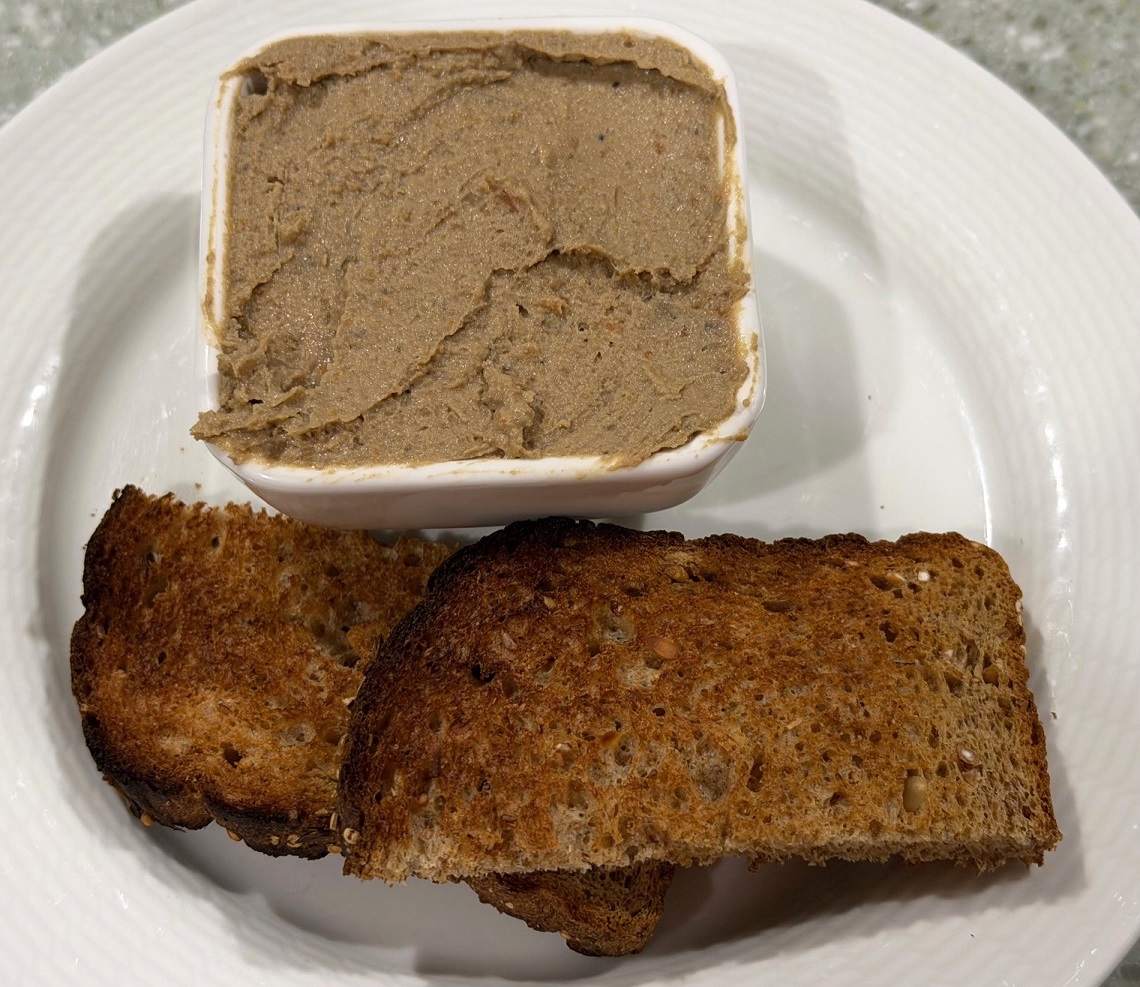
Two elements that I decided to add were cognac and green peppercorns. While making the chicken liver pate throughout the years, I tried different options, and found both irreplaceable, at least for my taste. So here is my new favorite recipe for the chicken liver pate.
Ingredients:
- 1 pound of fresh chicken livers
- 1 stick of butter
- 1 large red onion, sliced into 8 pieces
- 2 carrots, peeled and roughly sliced into big chunks
- 1 Granny Smith apple, cored and sliced into quarters (don’t peel it)
- 3-4 garlic cloves
- 1/4 of a cup Cognac or Brandy
- 1 teaspoon green peppercorns
- 3-4 bay leaves
- 3-4 allspice
- Salt and pepper to taste
Directions:
1. Preheat oven to 350 F
2. In a small roasting pan (I used a 9×9 glass pan), combine chicken livers, slices of carrots, onion chunks, apple chunks, garlic, 1/3 of the stick of butter sliced into chunks and placed evenly, bay leaves, and allspice. Add salt and pepper.
3. Put into the oven and bake uncovered for 45 minutes.
4. Take the pan out of the oven, add green peppercorns, and pour in the cognac. Mix the contents of the pan, and put it back into the oven for 10-15 minutes.
5. Take the pan out of the oven. Let it cool for 5 minutes or so. Remove bay leaves and allspice.
6. Transfer the content of the pan into a blender and add the rest of the butter (2/3 of a stick) to the blender in small chunks.
7. Blend until smooth, 2-3 minutes, scraping the walls of the can as needed.
8. Transfer into a glass container, let it cool off, and place it in the refrigerator for 3-4 hours (preferably overnight).
That’s all! Next, enjoy it with the toast or whatever way you like.
Notes:
1. Emeril’s recipe calls for soaking chicken livers in the milk for 2 hours in the fridge to remove bitterness. I have done it both ways, soaking and not, and I don’t see a difference. I didn’t soak it this time, and it was just delicious.
2. You can adjust the amount of green peppercorns to your liking. More peppercorns means spicier pate. But it is a mild spice.
3. Don’t substitute green peppercorns with black. The taste will be too aggressive. Green peppercorns are also softer, so if you use black peppercorns, the texture will be affected. If you can’t find green peppercorns in the store, you can buy them on Amazon.
4. Don’t substitute cognac with other types of alcohol (yes, you can use Armagnac or other brandy). Cognac brings both sweetness and a flavor profile that goes well with the other ingredients. I tried once using a bourbon, and the taste was ruined.
That’s all I have for you for now. But more of the simple recipes are coming.
Bon appetit!
And a Few Good Wines, Previously Was New Year 2026 Wine Escapades
For how long is it appropriate to celebrate the New Year?
Scrap that.
For how long is it appropriate to write a post about New Year’s celebratory wines? A week? Two? Four?
Okay, so as I’m writing this on the last day of the month, this is not a celebratory New Year’s post, but rather an account of wines we had an opportunity to experience.
As a tiny excuse to my tardiness, I want to mention that we celebrated the arrival of the New Year 2026 three times. So here are my notes from those celebrations.
Celebration #1- January 1st, New Year’s Day
To celebrate the New Year in style, I decided to do a Champagne-off between Pol Roger and Bollinger Champagnes. I have a lot of respect but very little experience with both, so I decided to compare them side by side.
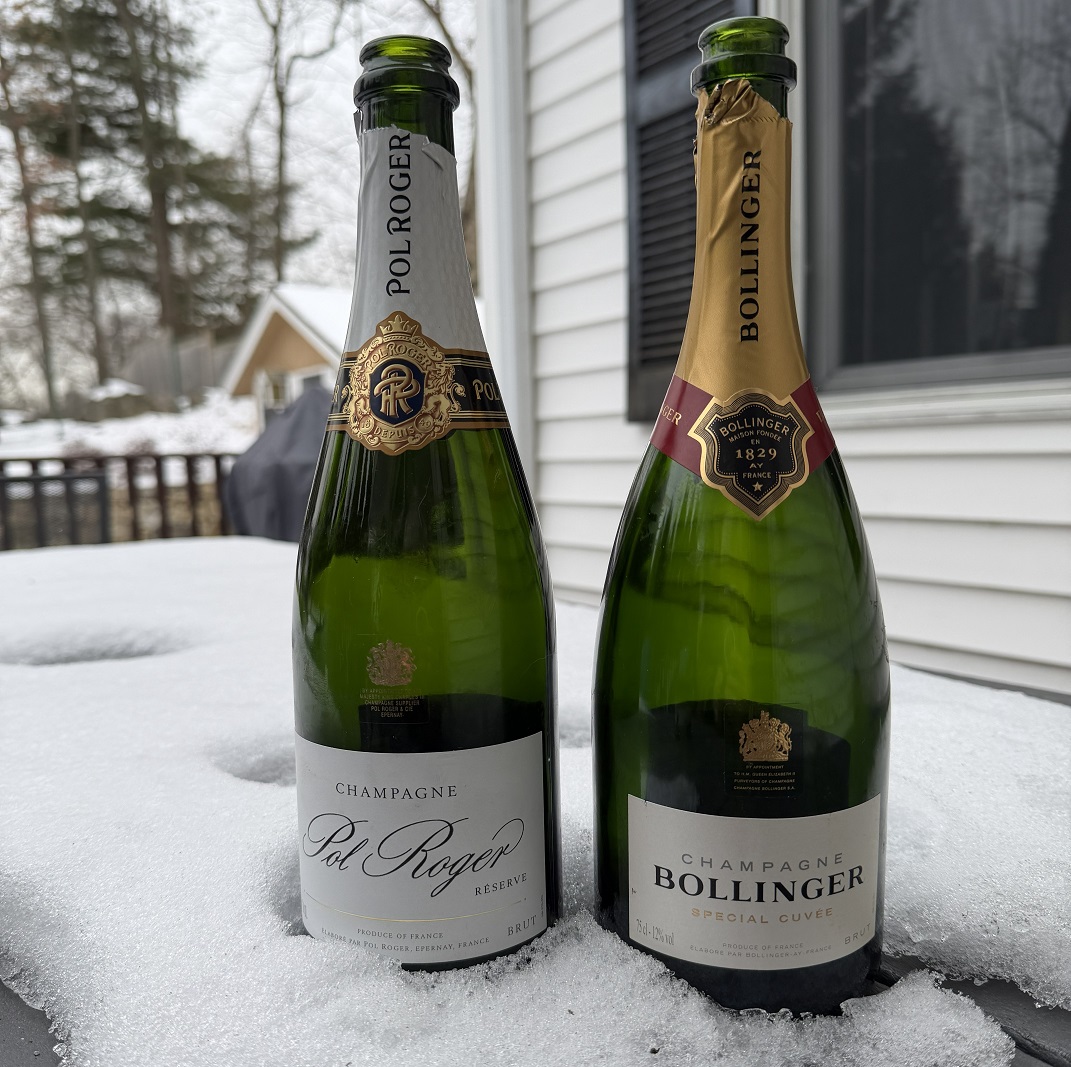
This was definitely an interesting experiment. Upon opening, Bollinger had a somewhat restricted nose, but nice palate with a hint of toasted bread, apples, and lemons. Pol Roger had a beautiful, inviting nose with freshly baked bread, minerality, and green apples. However, it was mostly flat on the palate, so after the first few sips, we decided to drink Bollinger first.
30-40 minutes later, I poured another glass of Pol Roger, and oh, the palate changed dramatically. Now there was everything you want in champagne – toasted notes of the freshly baked bread, apples, lemons, crisp acidity – all elegantly woven together. So while both Champagnes were excellent, my preference lies with Pol Roger.
NV Pol Roger Champagne Reserve Brut (12.5% ABV)
Beautiful, inviting nose, with toasted bread and apples.
Palate initially mostly closed, just acidity. After 30-40 minutes, the palate is alive with toasted bread, apples, lemon, minerality, crisp acidity.
8+
NV Bollinger Champagne Special Cuvée Brut (12% ABV)
Beautiful nose, apples, brioche
Restrained on the palate, lemon, crisp acidity, lots of energy, very elegant.
8, excellent Champagne
I also tasted this sparkling wine, even though it was mostly used in a delicious holiday cocktail:
2021 Casasetaro Pietrafumante Caprettone Spumante Methodo Classico Italy (12.5% ABV, 100% Caprettone (new for me!) grape)
Crisp, refreshing, with steely, minerally acidity. This makes you crave oysters in a heartbeat.
8, excellent
2019 Saxum James Berry Vineyard Paso Robles Willow Creek District (15.9% ABV, 55% Grenache, 29% Mataro, 13% Syrah, 3% Carignan)
Of course, 7 years is not an age when you want to open Saxum wine. Black fruit on the nose with some baking spices. Dark and brooding on the palate, black fruit, cocoa, a hint of the forest floor. A bit more mellow after being open for 3 days, more pleasant to drink.
8, delicious
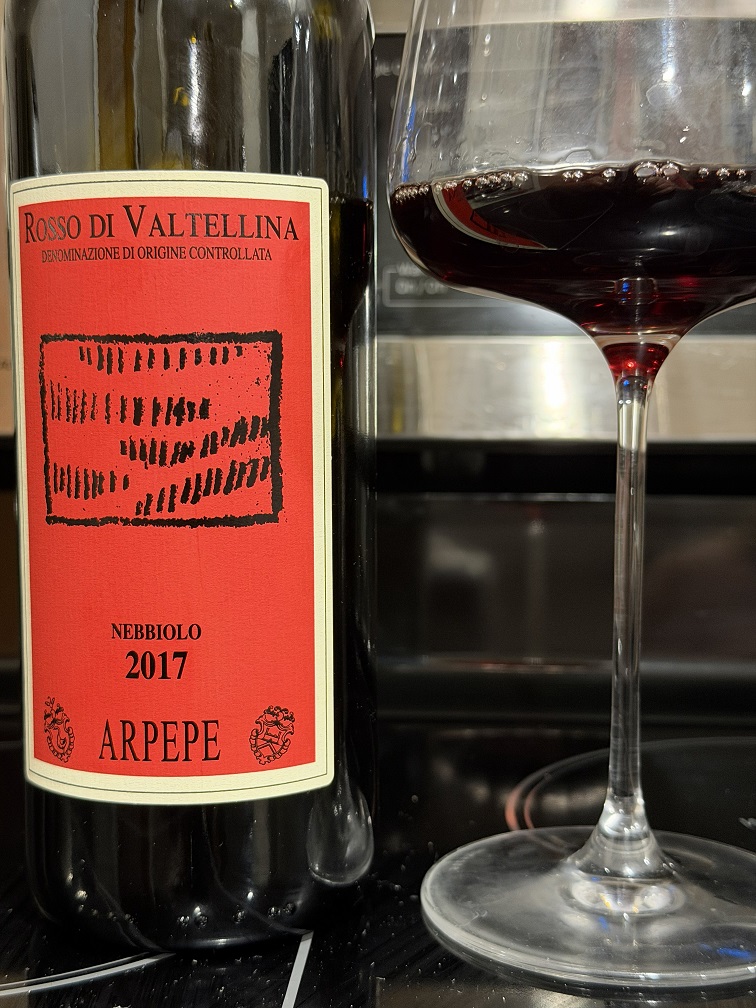
2017 ArPePe Nebbiolo Rosso di Valtellina DOC (13% ABV, 18 months total in big barrels and in bottle)
After a short breathing time, this wine showed brilliantly. Fresh cherries on the nose, restrained.
Cherries and violets on the palate, sandalwood, medium to full body, elegant, round, delicious. Glad we opened it.
8+, delicious
Second celebration:
On Saturday, we got together with friends to continue celebrating the New Year. This time, the wine lineup was a bit different, focusing more on the aged wines and the wines that might be past prime.
We started with a couple of Champagnes:
NV Veuve Fourny & Fils Champagne Brut Rosé Premiere Cru (12% ABV, disgorged 07/15)
Dark golden color
Apples, Almond extract, bread, tertiary aromas
Toasted bread on the palate, apples, brioche, cut through acidity even on day 6 after opening.
8+, while actual bubbles subsided, it was a very tasty wine. Really enjoyable even as a flat wine.
2017 Champagne Christophe Mignon Adn de Foudre Pinot Noir Brut Nature (12% ABV, disgorged 11/01/2024)
Bright Golden color
Apples and fresh bread
Apples, fresh bread, a touch of hazelnuts, cut through acidity. Very refreshing and very enjoyable.
8+, excellent, even on day 6
Next, this white wine was probably the most impressive out of all the wines we tasted that night:
2013 Domaine William Fevre Chablis Grand Cru Bougros (12.5% ABV)
Bright golden
A touch of gunflint, Granny Smith apples, lemon
Fresh, bright, apples, velvety smooth texture, great mid-palate presence, good structure, a distant hint of butter, impeccable balance.
9-/9, outstanding.
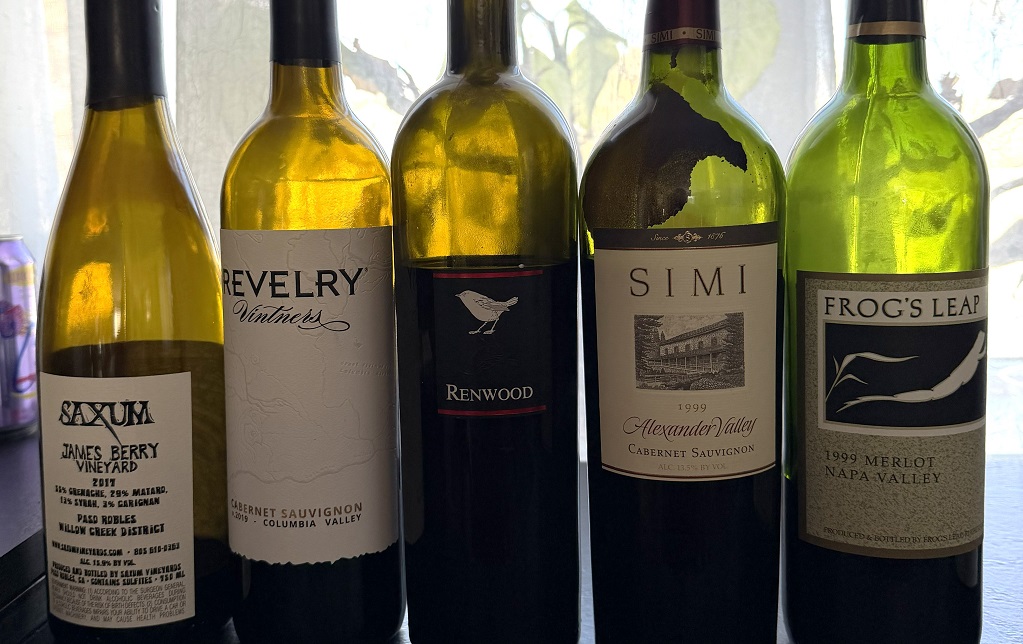
Then there were reds.
1999 Frog’s Leap Merlot Napa Valley (12.5% ABV)
1999 Simi Alexander Valley Cabernet Sauvignon (13.5% ABV)
Both wines were varietally correct upon opening, but it did felt that they were near the peak. No over yet, but having maybe only about 5 years of life left, before they will be officially declared past prime.
8- for each one.
2019 Revelry Vintners Cabernet Sauvignon Columbia Valley (13.9% ABV, 22 months in French oak)
Dark garnet
Cassis, blackberries, eucalyptus
Cassis, mint, blackberries, sweet basil, round, smooth, medium to full body, perfect balance, medium-long finish.
8+/9-, a beautiful wine.
1993 Renwood Grandpère Zinfandel Shenandoah Valley (15% ABV, Bottle #19727 of 1904 cases produced)
Dark garnet
Black fruit, good intensity
Tart blackberries, coffee, a touch of toasted hazelnuts, good acidity, still present tannins with a pleasant grip on the tongue, delicious.
9-, I wish more wines would have this energy and deliver this much pleasure
Celebration Number 3
The week after, we celebrated the New Year. Again. With friends, of course.
First, a couple of Champagnes.
NV Monmarthe Champagne Privilege Brut Premiere Cru (12.5% ABV, 50% Pinot Noir, 50% Chardonnay, aged for 36 months in the cellar)
Outstanding. Inviting nose, fresh apples with a touch of brioche.
Round, generous on the palate, roll-of-your-tongue delicious, fresh and elegant.
8+, excellent
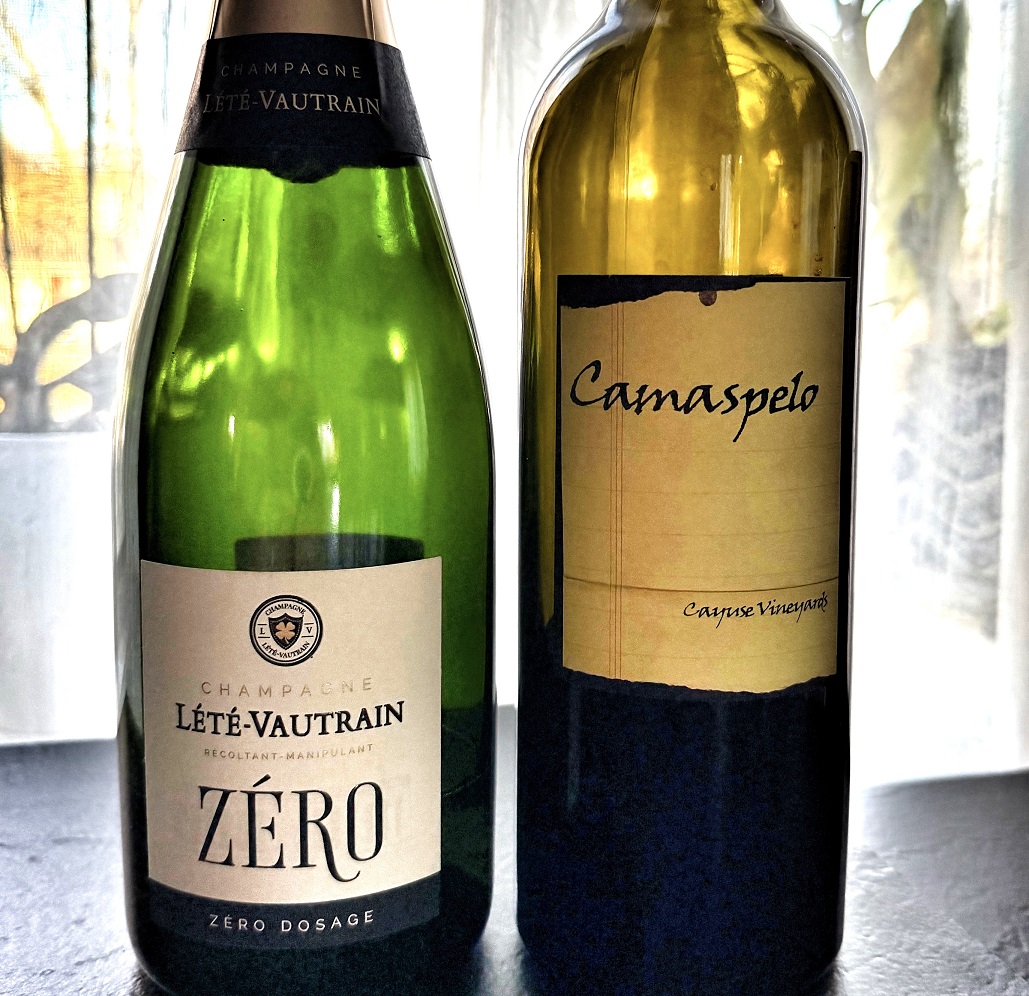
NV Lété-Vautran Chammpagne Zéro Brut (12.5% ABV, 40% Pinot Meunier, 40% Chardonnay, 20% Pinot Noir)
Crisp and fresh on the nose
Palate is crisp to the point of austerity. Elegant, full of energy, very lean.
8+, another wine that is begging to be paired with food
2022 Cayuse Vineyards Camaspelo Walla Walla Valley (13.8% ABV, Cabernet Sauvignon-dominant Bordeaux blend) – I know I was not supposed to touch this bottle, but I couldn’t resist the urge. This wine was clearly opened before its time. Probably 15-20 years would make it a bit more approachable from the get-go.
The wine was decanted, and yet the mineral, volcanic profile was the most prominent, same as with most any of the Cayuse wines in any case. After 2-3 days, the volcanic notes subsided, and the wine appeared more drinkable and enjoyable.
8, definitely needs time
2009 Tallulah Cabernet Sauvignon Napa Valley (14% ABV) – this was my last bottle. The wine was supposed to be special when I bought it, but it never reached that point. Well, until now, but with some reservations – even after decanting this wine, I had to wait for another 3-4 days for the wine to shine in varietally-correct way. But it did. It actually developed a cassis/mint/eucalyptus profile with a dash of dark chocolate.
8+ after extensive decanting.
There you have it, my friends – New Year 2026 wine escapade.
How was your January?
Struggles of the Winelover

Source: Pexels Cup of Couple
Yes, I’m on the streak. A self-focused experiment. I’m curious to see how many posts in a row I can write. Not just “hello – goodbye”, but posts with substance. Well, whatever. This is definitely not the topic of this post.
Oh, and here is a full disclosure – this post is about first-world problems. If you are not interested, you know where to click.
I bet you had no idea that winelovers struggle. No, not when we enjoy a glass of wine. When we enjoy wine, we simply ask for another glass. And no, not when we don’t enjoy wine. Then it is a very simple ask: “Can I have something else, please?” It is really that simple. If you don’t like the particular wine, there is no struggle – you just move on to the next.
The struggle starts when we need to choose the wine. At that moment, the struggle is real. A chain of thought might depend on the setting, but the unending back and forth is always the same.
When you are presented with the wine list at a restaurant, you need to decide based on price, based on mood, based on company, based on food. It always goes “this. Wait, no – this one. Hmmm. No, let’s go to a different region. Ah, yes, this one. No, wait, maybe this? Why is this so expensive? Ohh, why is this so cheap?” Well, got you. The last one is not real. If you know what you are doing, “why is it so cheap” is not the question you concern yourself with. But the rest of it? If you love wine and have ever chosen a bottle in a restaurant, tell me that I’m wrong. I dare you. Tell me that in the comments section. Go ahead, make my day.
The second one might be even worse. Now you need to select a wine for a dinner, get together with friends, a holiday, a birthday, an anniversary – you got the idea, right? This is where the struggle becomes even worse. When you need to choose a wine in the restaurant, you have a limited amount of time and a reasonably limited wine selection. None of it is in play at home. You start worrying about the wine months and months before the event – you can choose not to, of course, but only if you let yourself do this. Now think how many of us allow ourselves not do it, huh?
And here you are really screwed, as you have plenty of time to go “This! No, wait, that! Wait, no, no, I need something else”, following with “Is it too early? Can this already be past prime? It is my only bottle, should I open it now? What if it will be so much better in 10 years?”. And let’s not forget “Will they like it? Is that a good choice for that holiday? Is that special enough for the occasion? Maybe I can do better?” On, and on, and on. Endless. Frustrating. Annoying.
Why all of a sudden all of this soul-pouring sentiment? That’s easy, let me explain.
Any February is a tough month for the struggling winelover. You got Valentine’s Day in the middle of the short month, and then you have Open That Bottle Night (OTBN) on the last Saturday in February. And to add to the struggle, this particular February, we are flying to Florida to see our close friends, and they will have their wedding anniversary during our visit, so I definitely feel that I need to bring something appropriate to celebrate. There you go – three opportunities to struggle.
Source: Pexels Polina Tankilevitch
I still don’t know how we are celebrating Valentine’s Day. I’m sure we are not going to the restaurant, but we might decide to have some company. And it falls on Saturday this year, which is all the more reason to select a good bottle(s). In any case, what should we drink on Valentine’s Day? Yes, bubbles first, that is clear, but even that presents a dilemma. And what should follow the bubbles? What kind of red wine offers the best pairing for Valentine’s Day? If you have any thoughts – go ahead, don’t be shy.
Then the wedding anniversary – do I even have the right bottle for that? I have some vintage Champagnes, but nothing grand enough for the occasion. And while my friends generally like the wine, they are not wine geeks, so well-aged reds might not solicit the response I would want.
Last but not least is the mother of all winelover struggles – OTBN. The holiday was invented to help people crack open that special bottle still waiting for the right moment, which might never come. And yet OTBN is only one night, how many bottles can you open? Selecting the bottle for OTBN is ultra-difficult, especially when one has lots of wines in the quantity of … 1. When you have only one bottle, you need to decide if this is really the time, if the bottle can still improve, if the bottle is special enough. Ah, and please understand that “special” doesn’t mean “expensive”. A special bottle is simply a bottle with an attached memory, and for OTBN, we need to ensure that the bottle is special enough.
Here, I just shared my frustration with you, and I feel better. I even got some ideas for the wine to open on Valentine’s Day. And I’m pretty much decided on the OTBN bottles (it means nothing, really, everything can – and will – change quickly). But I do feel better at the moment.
So what would you tell me? Is this struggle real, or am I a spoiled, undeserving brat? You be the judge of it, but I know how it feels selecting a bottle for a month, in the endless loop between all the wine fridges and shelves. For me, it is definitely real. And for you? Hey, do tell your stories, I’m all ears…
An Easy Way Into The Wine World: Stikky Wine
The world of wine can be anything you want it to be. It can be snobby. It can be snooty. It can be intimidating. It can be just plain difficult. Thousands upon thousands of labels multiplied by thousands of people with attitude… Grrrr…
But it doesn’t have to be difficult, intimidating, or snobby. It can also be easy, fun, and friendly. Especially if you have a friend who knows a thing or two about wine and is willing to teach you. Sometimes your friend can be a person, but sometimes it can be simply … a book!
Enters Stikky Wine book.
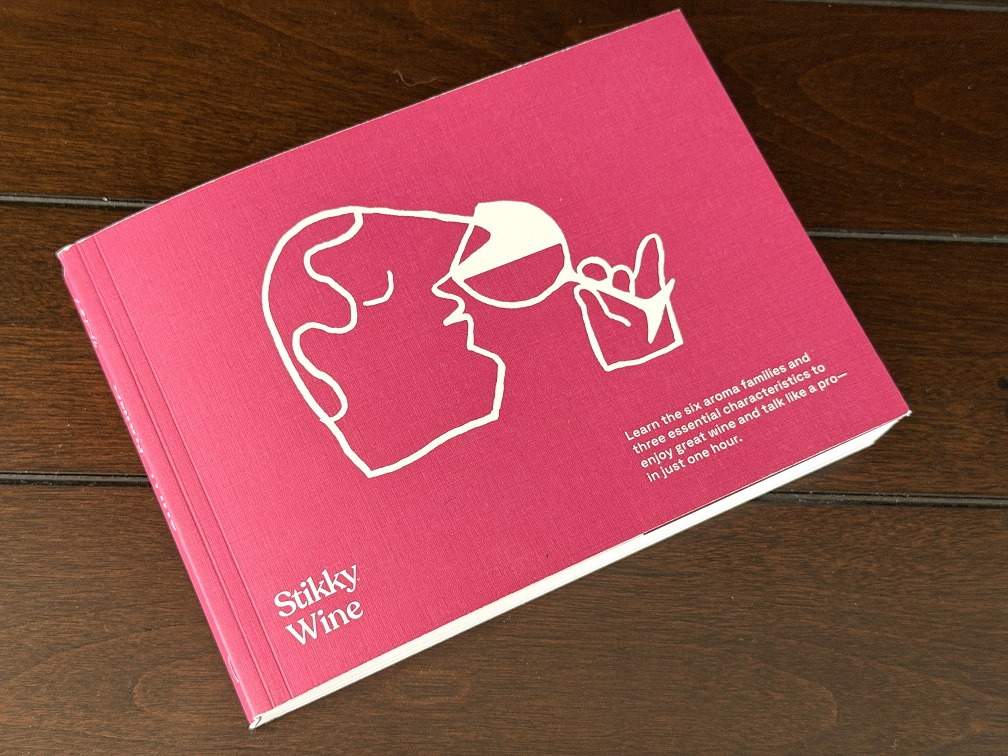
A comfortable format – it doesn’t look like an encyclopedia you can’t lift off a shelf unless you bench at least 135 on a regular basis. Stikky Wine can easily fit in the palm of your hand. It is easy to navigate, and its only purpose is to be your wine friend.
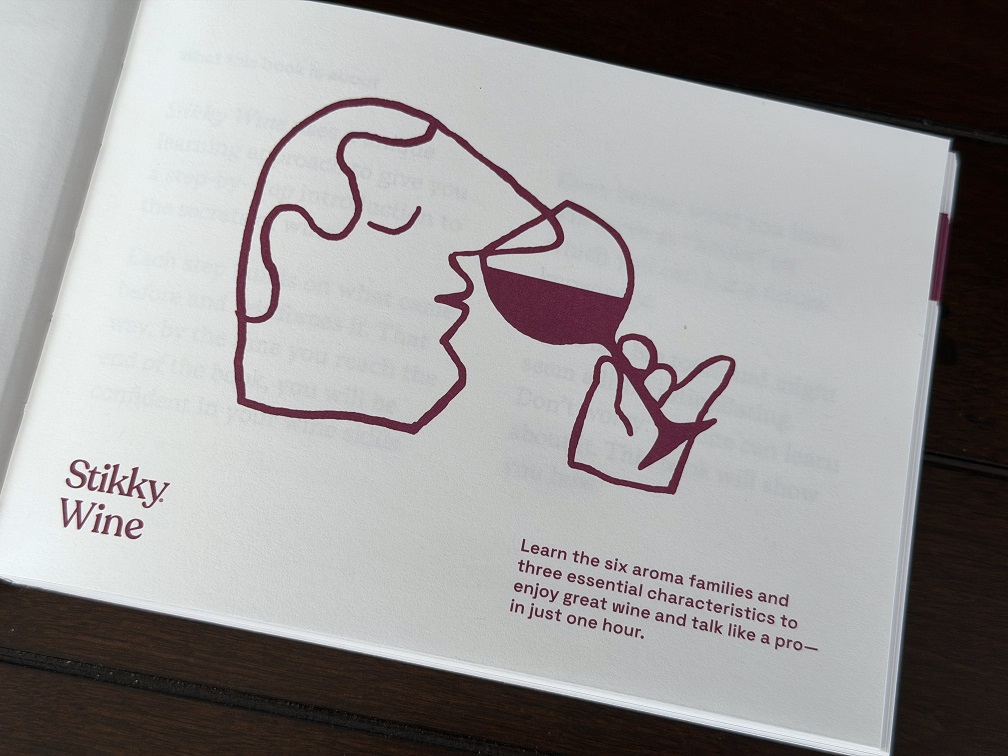
As you open the book, it tells you all you need to know about what follows: “Learn the six aroma families and three essential characteristics to enjoy great wine and talk like a pro – in just one hour”.
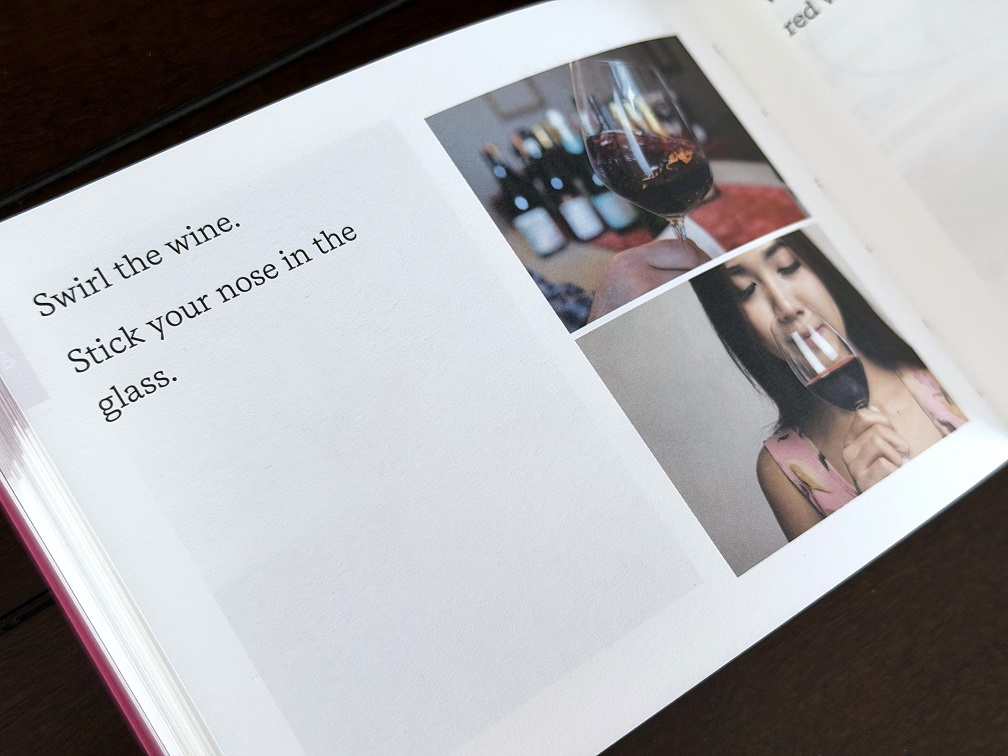
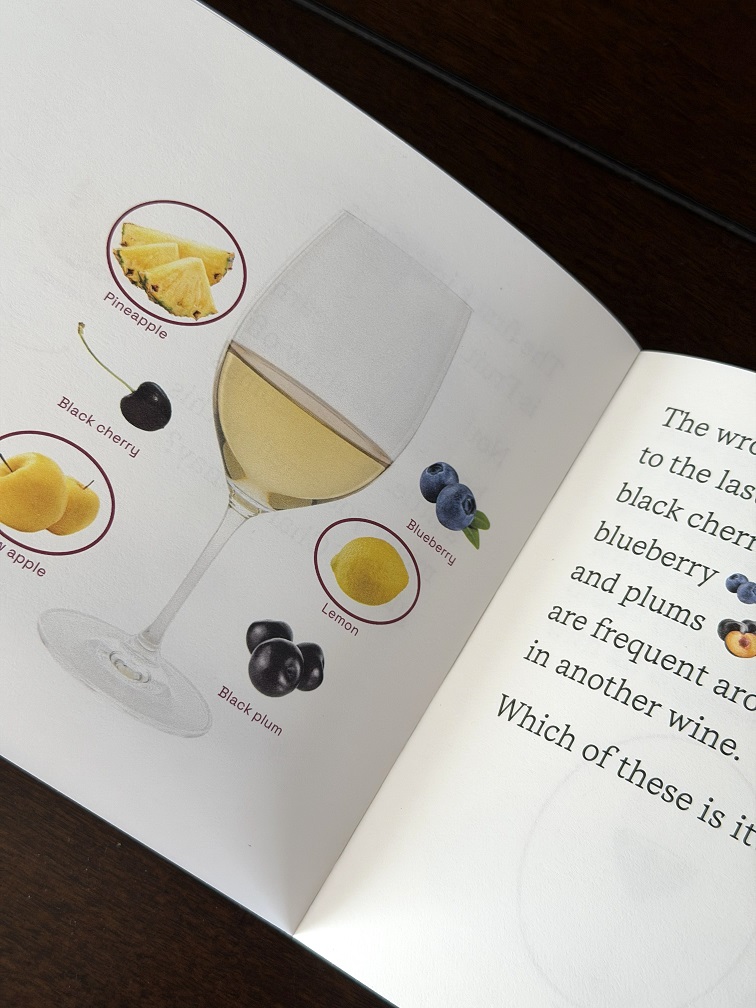
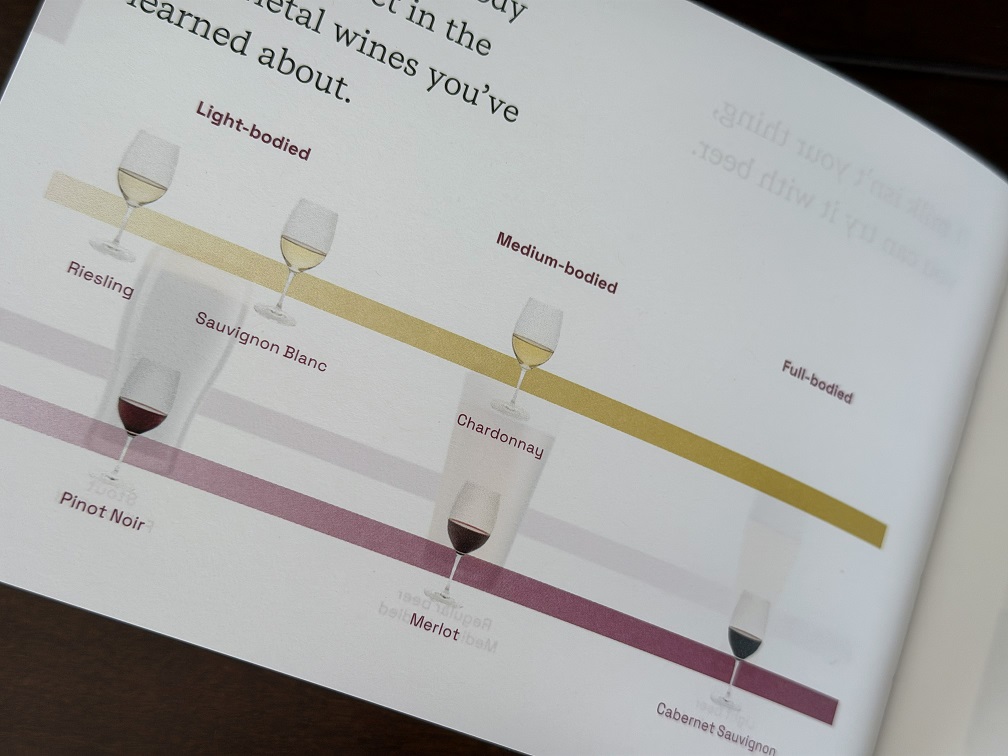
It sounds like a bold promise, but it is not far from the truth. With simple, step-by-step instructions, the book helps you learn about basic aromas in the white and red wines. You will learn about the 6 most widespread grapes, 3 whites and 3 reds, and you will learn how to differentiate between them. All throughout the book, before you turn to the next page, there will be a question you need to answer [without cheating] – and this will help you to remember what you have learned.
By the end of the first chapter (called Sequence One in the book), you will know how to speak wine fluently. The wine descriptors, such as fruit, acidity, herbs, earth, and spices will leave your tongue without any effort. You will also pick up some fun facts, such as the movie Sideways, for example.
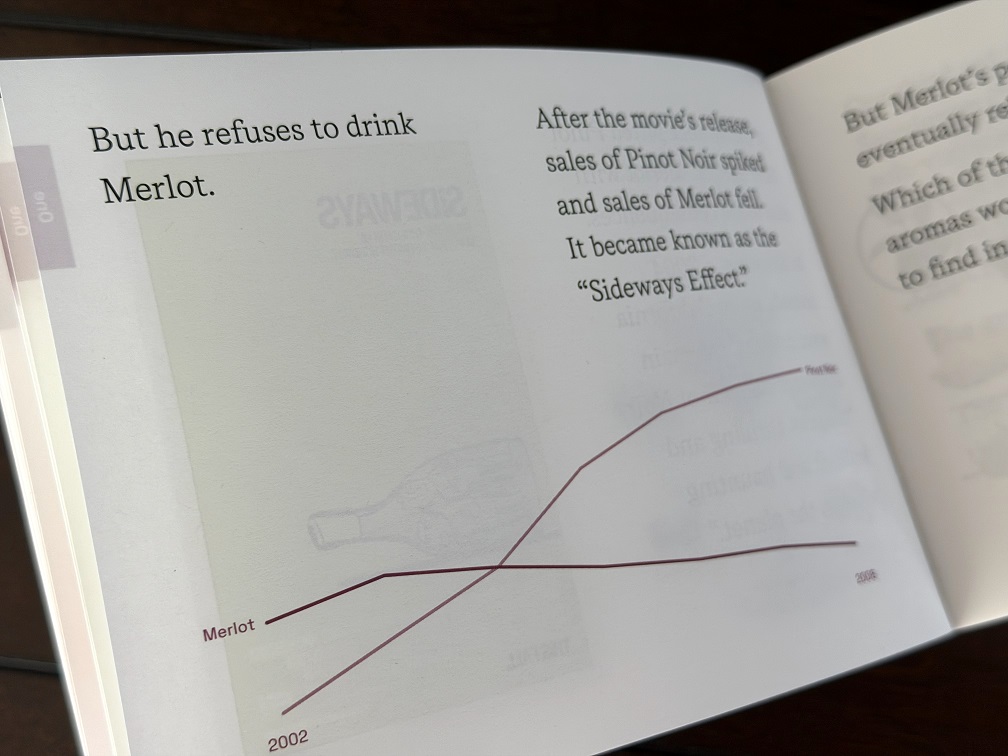
In the second chapter (Sequence Two), you will learn about wine service, choosing the wine in the restaurant, and some of the wine faults. Basically, if you follow the book’s instructions, you will soon change your perspective about the wine world from “difficult and intimidating” to “fun and easy”.
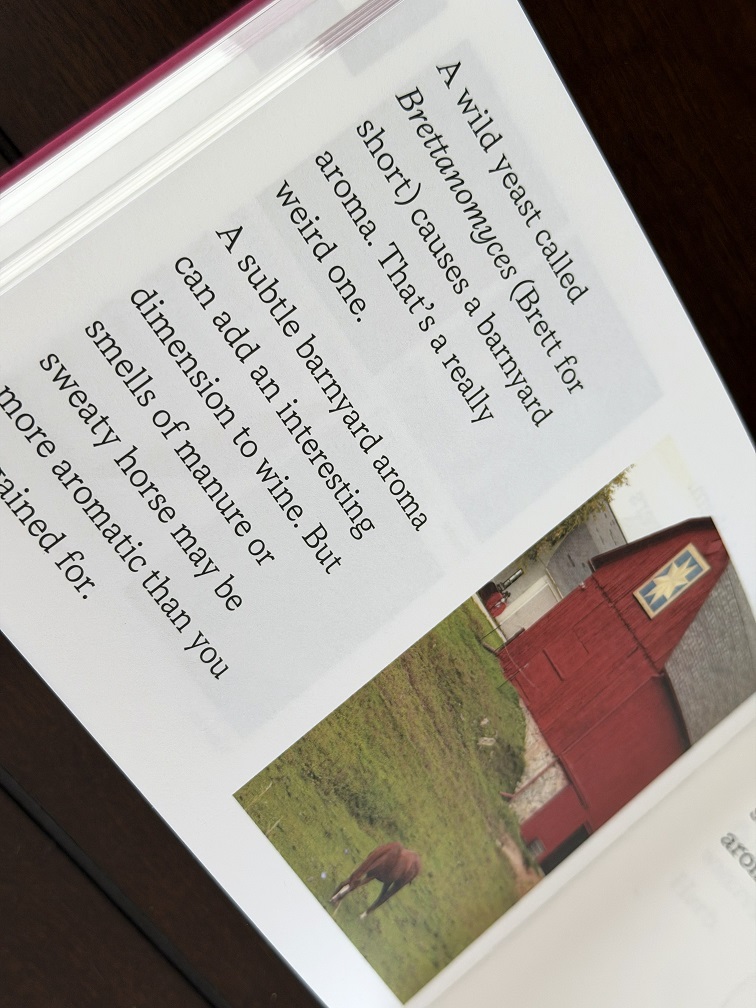
I had a lot of fun going through the book. I’m sure this book will benefit everyone who has ever been intimidated by the world of wine, and this new knowledge will definitely make wine more enjoyable for everyone who will make an effort to read and study. Hey, the study here is the most fun part – it means you get to drink wine, and all of it for the benefit of learning!
What are you waiting for? You can get your Stikky Wine book here. And you can thank me later.
A Weekend In Wines #4
Here we go again – another attempt at a series (I kind of question my mental health at the moment, as the definition of insanity is trying the same thing over and over again, each time expecting a different result – I’m so glad I’m not a doctor, whew).
Some time ago, I wrote a post called Weekend in Wines. Then there was A Weekend In Unique Wines. And also A Weekend in [Great] Wines. That makes it 3 attempts at the Weekend in Wines theme, hence the #4 in the title. Oh yes, and countless posts under the same name, which never left my head, never materialized in the form of letters and pictures on the screen. But those don’t count, don’t they? Okay, number 4 it is.
It is not every weekend that I experience the wines I feel an urge to talk about. But from time to time, the “weekend wines” turn out truly special, especially if we are meeting with friends or traveling somewhere just for a weekend. The name “Weekend in Wines” feels appropriate, so let’s see how far I will be able to get with this.
There is another interesting question: when does the wine weekend start? Well, it is not all that important, but sometimes I open an interesting bottle on Thursday, knowing that I will finish it on Friday, just to see how the wine will “age”. But then again, let’s not bother ourselves with small details.


The weekend in wines #4 actually started on Thursday, with 2022 Pazac Le Pigeonnier Costières de Nîmes AOP (14.5% ABV). Truth be told, I’m not a big fan of the Southern Rhone wines, I find them flat for my palate. So I had no expectations opening this bottle – and then was pleasantly surprised with a generous fruit, medium+ body and nicely contrasting acidity. Well drinkable and offering a good amount of pleasure (Drinkability: 8-). I pumped the air out and left the bottle on the counter until the next day – and on the next day, the wine started losing its “umph”, simply confirming that Southern Rhone wines are not built for ageing.
I needed something else to drink on Friday, then, and I pulled 2021 Field Recordings Nolan Alisos Canyon AVA (13.9% ABV, 100% Alicante Bouschet, Nolsn Ranch vineyard) from the wine fridge. I was first introduced to the Alicante Bouschet grape more than 20 years ago, in the guided tasting of Spanish wines at the Barcelona restaurant in Connecticut. Ever since, I had many pleasant encounters with wines made from this unique Teinturier grape. A quick explanation, if I may – Teinturier grapes have red skin and red flesh/juice, which is very unique – only about 20 grapes are Teinturier out of many thousands used in the winemaking (Georgian Saperavi is another good example of Teinturier grape). The absolute majority of the red-skinned grapes have clear juice. While coming originally from Spain, Alicante Bouschet is a popular grape in California, more as a blending grape, but also used in the single varietal wines by the likes of Carlisle and Turley. This wine was powerful and brooding, almost black in color, with cherries, roasted meat, and a bit of funk, well within the “pleasure boundaries for my palate. (Drinkability: 8)
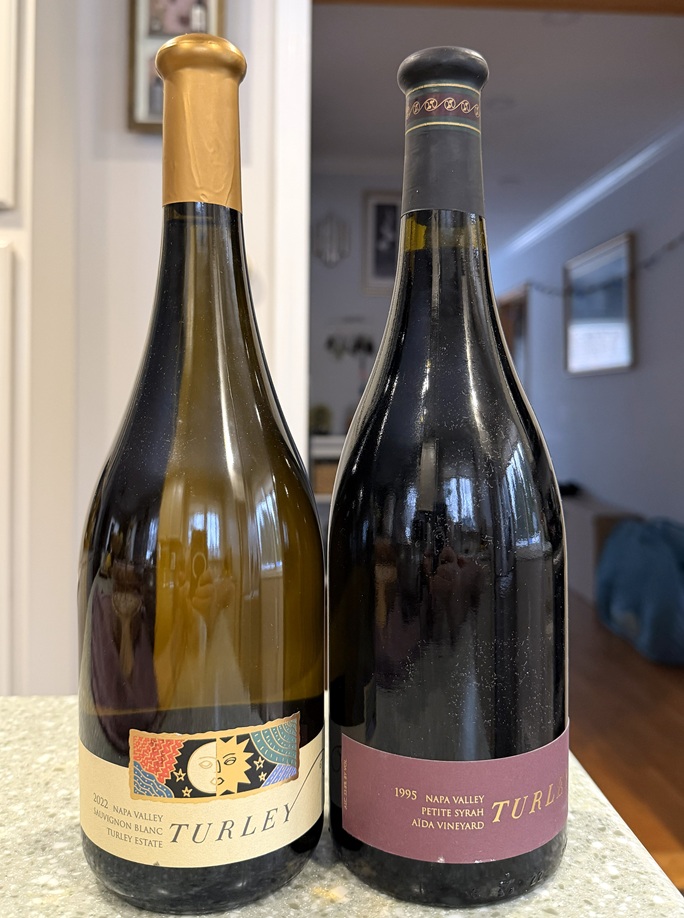
On Saturday, we were visiting our friends Francesca and Stefano, and of course, I had the pleasure nightmare of selecting a couple of special bottles to bring over. After a prolonged, painful back and forth, I finally settled on two bottles of Turley. First, 2022 Turley Sauvignon Blanc Estate Napa Valley (13.2% ABV). Turley Sauvignon Blanc is one of my perennial favorites. I had multiple vintages of this wine, and I have to say that Turley Sauvignon Blanc is always in a league of its own. You can’t provide a simple frame of reference, such as “oh, it is so much like Sancerre”, or “Similar to New Zealand”, and so on. The wine has great energy, it is round, it is silky, it is polished, it offers white stone fruit with good mid-palate weight, and a perfect balance. Always a treat. (Drinkability: 8+).
The next wine was an amazing treat. I recently got this 1995 Turley Petite Syrah Aida Vineyard Napa Valley (13.5% ABV) directly from Turley via the last mailing list offering. I’m on the Turley’s list probably for the past 15 years, I love Petite Sirah (Turley uses the spelling of Petite Syrah for some reason), but I never saw Petite Sirah from Aida Vineyard on any of the offers. We had to decant the wine as we were not careful pulling out a 31-year-old cork. I know that Larry Turley, the founder of Turley Winery, often said that Zinfandel is the wine Cab lovers actually want to drink. I know that this is Petite Sirah and not Zinfandel, but this 1995 Petite Sirah was truly mesmerizing – and Cabernet-like. In a blind tasting, I would not doubt that I’m drinking California Cabernet Sauvignon even for a second. The wine had a beautiful, succulent berry profile, with cedar box, eucalyptus, and mint, a fresh, zippy, and joyous palate. The tannins were perfectly integrated but still present, acidity was in check, ensuring the absolute freshness, and overall impeccable balance. A gem. (Drinkability: 9-/9).
Ahh, and one more interesting tidbit – the delicious pairing of this Turley Petite Sirah with Pasta Bolognese we had as a first dish. I would never think of pairing Petite Sirah with a pasta dish, as generally it would overpower it. However, this 30-year-old Petite Sirah mellowed and evolved enough to create a delicious pairing, complementing and enhancing the flavor. Love good surprises!


I asked Stefano if he had any Valtellina Sfursat in his cellar, as I was all of a sudden craving this expression of Nebbiolo after an earlier conversation on Twitter. He didn’t have the Sfursat, but he came back with 2001 ArPePe Sassella Rocce Rosse Reserva Valtellina DOCG (13% ABV). I love ArPePe wines, but they are generally not easy to find in the US. Interestingly enough, this wine literally showed no signs of age. It looked like it was just made, with cherries, sandalwood, violets and a touch of sapidity. To be entirely honest, I literally wanted this wine to show some age, maybe with some dried fruit notes, and it didn’t. I guess it would take another 20 years for it to reach its peak. Oh well, it was still tasty. (Drinkability: 8/8+).
And the last one for today – 2009 Carole Bouquet Sangue d’Oro Passito di Pantelleria, Sicily (14.5%). Once again, I was obnoxious enough to ask for Vin Santo to have with dessert. Stefano didn’t have any Vin Santo on hand, so he came back with this wine. I never heard of the producer, but the appellation is well-known for producing dessert wines from the Muscat of Alexandria grape, locally known as Zibibbo, with Donnafugata Ben Ryé being the most exemplatory specimen. It appears that this wine is produced by the famous French actress, Carole Bouquet, and it is not easy to find in the US. As the name of the appellation says, the wine is produced using the “passito” method, where the grapes are dried for a number of months before they are pressed into the wine, greatly increasing the concentration of flavors. The wine was delicious, loaded with succulent, ripe apricots with perfect acidity. Seductive, round, voluptuous – a perfect finish to a great evening with friends (Dinkability: 8/8+).
There you are, my friends. A weekend in wines. A weekend in great wines. A weekend in unique wines.
To more great wine weekends – cheers!
Celebrate Port!
 This might be a first for me – I don’t think I ever posted twice in one day for more than 15 years this blog has been in existence. Well, there is always the first, right? And no, I’m not trying to compensate for the dismal amount of posts over the last year (well, maybe just a tiny bit, but please keep it a secret).
Earlier today, I wrote about the grape holidays for the year 2026, and the first thing that caught my attention was the grape holiday occurring today, January 27 – an International Port Day (interestingly enough, we also have a National Port Day, which is celebrated in September – and we don’t even live in Portugal, go figure).
Port is generally known as a fortified dessert wine. In a perfect world, Port should also be known as the wine produced in Portugal, similarly to Champagne, which can only be made in Champagne, France. However, Port is better known as a dessert wine category, and the name Port is widely used (abused?) by many producers, at least in the US (go to the wine-searcher and search for Zinfandel Port, for example). But let’s focus on the Port coming from its place of origin, Portugal.
Port is a sweet wine, usually having 17% – 22% ABV and 90 to 150 grams of sugar per liter of wine. Well-made Port is absolutely delicious, the same way as Sauternes, TBA Riesling, or an Ice Wine. The key to the sweet wine being delicious lies in the balance – as long as sugar is balanced with acidity, that’s all the wine lover needs to enjoy it.
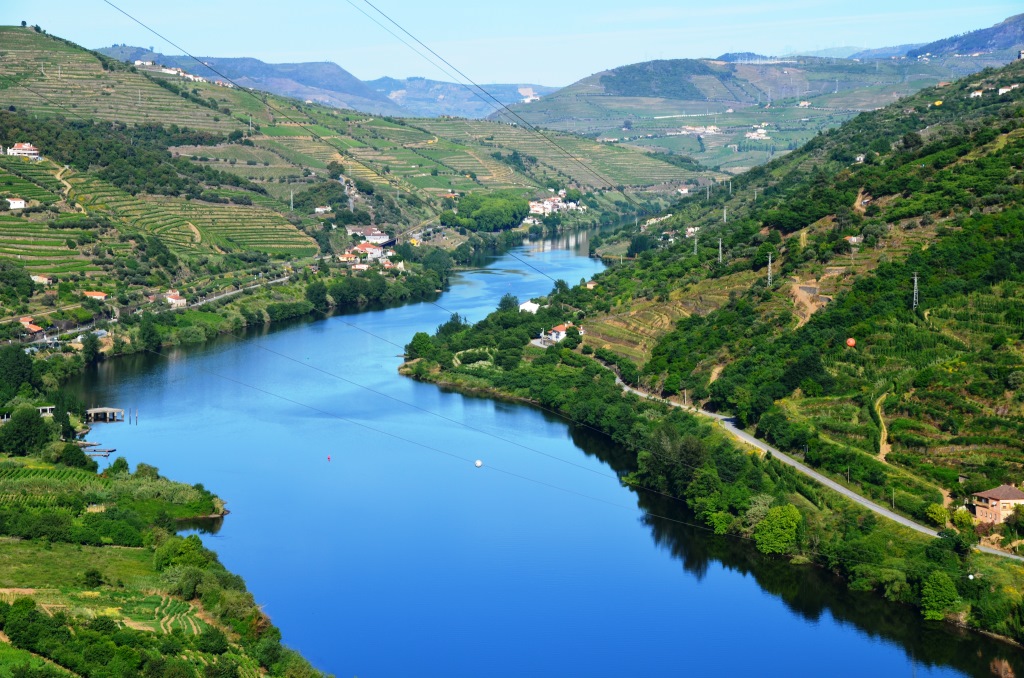
Port used to be the wine of the kings, almost a liquid currency, produced in the Douro region in Portugal, the first demarcated wine region in the world (this tells you how important Port was). Here is one of my favorite pictures used over and over in this blog – just look at this beautiful Douro Valley:
 And yet today, Port is reduced to a little corner in the wine stores, and sometimes the “by the glass” selection in the restaurants’ wine lists.
I don’t know why Port is not as popular as it should be. I’m sure that one factor is a “sugar shame” – we are trained to be ashamed to admit that we like something sweet, so many people would purposely avoid it. Another factor probably has to do with the complexity of the Port styles – there are just too many of them. Just as an illustration, here is a mind map I created for the post where I’m talking about all the different types of Port:
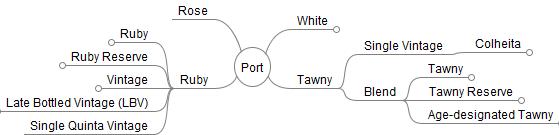
And even the picture above doesn’t cover all the corners – for example, age-designated tawny can be of 10, 20, 30, 40, over 40, and as of recent, even 50 years old. Oh, if you want explanations for this picture, you will find them in this post here.
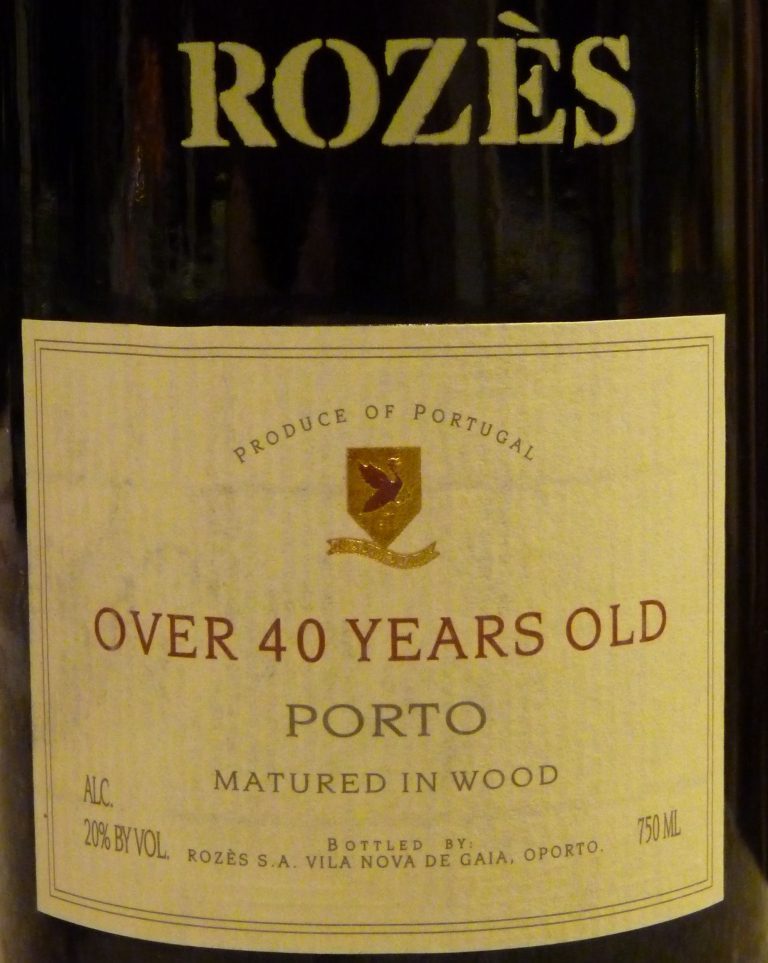
As we are talking about celebrating Port, I have two particular memories I want to share. The first Port I was absolutely mesmerized by was Rozès Over 40 Years Old Porto – I had this wine about 15 years ago, and still, I can close my eyes and relive the magnificent encounter with this elixir – the beauty and complexity of the elegant, fragrant liquid. This wine was #2 on the inaugural Talk-a-Vino 2010 Top Wines List, and you can read more about that encounter here.

1970 White Port
The second most memorable Port experience was with the 1970 Quevedo White Port. We tasted this wine in the cellar of the Port producer Quevedo, directly from the barrel, as Oscar (the winemaker) didn’t know what he could do with the 43-year-old White Port. This 1970 Port became my wine #1 on the 2013 Top Wines list – you can also read about my tasting experience here.
I’m absolutely convinced that Port is the wine well worth celebrating, so happy International Port Day to you!
What are your best Port encounters you remember? Don’t be shy, you know what to do…
Last Bottle Sign Up ($10 credit)




 Talk-A-Vino